AI slop: its impact on social media and business

Today you can open almost any social media platform and within a few minutes it may feel like you've already seen that post somewhere before. Every day, we come across content with repetitive headlines, similar writing styles, generic advice, and nearly identical visuals. Much of this is driven by the growing amount of low-quality content generated by AI.
Overall, the volume of content continues to increase, but truly memorable and original posts are becoming harder to find. At the same time, this creates a new opportunity: the more repetitive content fills users' feeds, the more valuable authentic publications become - those based on real experience, unique insights, and a brand's own voice.
What is AI slop?
The Merriam-Webster Dictionary defines slop as low-quality digital content that is typically produced at scale using artificial intelligence. AI slop is usually easy to recognize. It relies on generic responses, tries to appeal to everyone, rarely introduces original ideas, and avoids specific or practical insights. As a result, these posts become interchangeable and difficult to distinguish from one another.

It is important to distinguish between AI-generated content and AI slop. Artificial intelligence itself is a productivity and creativity tool, while AI slop is essentially digital junk. The key difference lies in the value the content provides to its audience, whether it reflects genuine expertise, and the purpose for which it was created.
At first glance, there may seem to be nothing wrong with this. Businesses can publish more content, keep their social media feeds active, and reduce the time and cost of content production. However, when quantity becomes the primary goal, it gradually starts to affect audience engagement, brand perception, and overall marketing performance.
Why is AI slop becoming a problem for businesses?
The main issue with AI slop is that the number of posts begins to outweigh their quality. Content is produced simply to maintain publishing volume rather than to engage the audience or solve their problems. As a result, its effectiveness gradually declines.
According to a study by the video editing platform Kapwing, 21% of YouTube recommendations shown to new users consisted of AI slop. The same study found that another 33% of recommendations were repetitive, low-value videos created solely to capture users' attention without offering meaningful information. These videos often follow identical formats, provide little or no real value, are published at scale, and do not always contain reliable information.
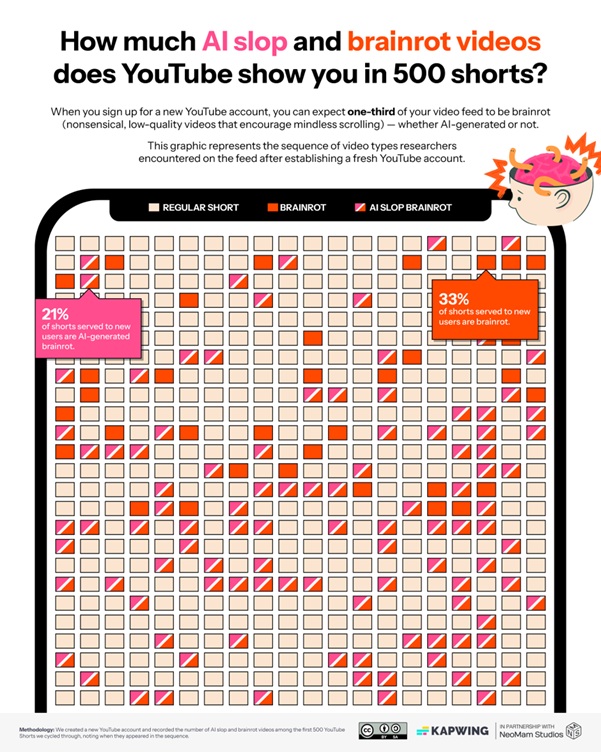
*The share of low-quality AI-generated content in YouTube recommendations
However, relying on AI slop can have several negative consequences for businesses:
- Lower engagement. Users can tell when content feels generic or mass-produced, so they simply scroll past it without liking, commenting, or saving it.
- A weaker brand identity. When your content starts to resemble everyone else's, it becomes much harder to maintain a distinctive brand voice.
- Declining audience trust. Repetitive, low-quality content makes users less likely to view your brand as a credible and reliable source of information.
- Weaker algorithmic signals. Posts that receive fewer views, comments, shares, and saves are less likely to be recommended by social media algorithms.
- More content doesn't mean better results. Filling users' feeds with more posts won't improve reach or engagement if the content fails to resonate with your target audience.
As a result, AI slop can negatively affect not only how people perceive your brand but also key social media performance metrics, including reach, engagement, watch time, saves, shares, and the overall distribution of your content.
How to create content that doesn't look like AI slop?
Content that stands out in today's crowded social media landscape doesn't have to be perfect. It simply needs to feel authentic, reflect real experience, and demonstrate genuine expertise.
AI can certainly help generate ideas, organize your thoughts, or edit your writing. However, it is the human perspective that makes content memorable, engaging, and valuable to readers.

Here are a few principles that can help make your content feel more authentic and valuable to your audience:
- Your unique voice matters more than perfection. People don't connect with content that feels generic or impersonal. A distinctive writing style, a clear point of view, and original insights help your content stand out in a crowded feed.
- Specific examples are more powerful than generic advice. Instead of relying on broad recommendations, use real examples, data, and measurable results. For instance, the advice "Post consistently" is easy to forget. Explaining how publishing three videos a day for two weeks increased your reach by 40% is much more memorable and credible. Details make content more engaging and trustworthy.
- Original opinions outperform generic recommendations. If a post can be copied and published by thousands of other accounts without any changes, it is unlikely to leave a lasting impression. Brands build recognition through expertise, unique perspectives, and original ideas.
- Write the way people actually speak. If a sentence sounds unnatural in a real conversation, simplify it. The more natural and conversational your content feels, the more likely people are to perceive it as authentic.
How could AI slop change the internet?
The amount of AI slop continues to grow because it is quick to produce, easy to scale, and, in most cases, does not violate platform policies. As a result, it is unlikely to disappear anytime soon. At the same time, user expectations are changing. People are paying closer attention to content quality, the reliability of information, and the practical value a publication provides.

Several trends are already becoming apparent:
- Transparency will become a competitive advantage
People increasingly want to know whether a real person was involved in creating a piece of content. Was the voice recorded by a human or generated by AI? Was the image captured with a camera or created using an AI image generator?
In the future, brands will likely need to be more transparent about their content creation process, clearly communicating where AI was used and where the work was done by real people.
- Trust will have to be earned again
As the internet becomes flooded with repetitive, AI-generated content, people are becoming more cautious about the information they consume. Even ordinary photos, videos, and customer reviews are beginning to raise doubts.
As a result, brands will need to demonstrate their expertise more consistently by sharing real case studies, original insights, and authentic experiences.
- People will want more control over their feeds
Many users are growing tired of repetitive content and finding it increasingly difficult to discover original, genuinely valuable posts. As a result, they want greater control over the content recommended to them, with more visibility for publications from verified authors and less repetitive, low-value content appearing in their feeds.
Conclusion
AI slop is not a problem caused by artificial intelligence itself. It is the result of using AI without a clear purpose or strategy. As content becomes easier and cheaper to produce, audiences place even greater value on expertise, authenticity, and meaningful insights.
The brands that will succeed are not necessarily those publishing the highest volume of content, but those that use AI as a tool to enhance their work while continuing to create content that people genuinely trust.

Try Popsters Trial plan to get content activity statistics of any pages for a next 7 days for free
Try for free
Popular
-
 Analytics and Statistics for Any Telegram Channel or Chat
-
 Instagram Statistics and Analysis: How to View Data of any Account
-
 How to Remove fake Followers on Instagram and Is It Necessary?
-
 How to Increase Telegram Subscribers: Best Free Ways
-
 YouTube Analytics and Statistics for Other Channels
Try Popsters Trial plan to get content activity statistics of any pages for a next 7 days for free
Try Popsters