Social media as search engines: how users search for brands and products

When choosing cosmetics, looking for a restaurant, or comparing tech products, users turn not only to search engines but also to social media. There, they can watch unboxing videos and product reviews, read customer feedback, find recommendations, and learn about potential issues they might encounter after making a purchase.
Social media has become another source of information that helps people make purchasing decisions. That’s why companies need to understand what information potential customers are looking for and create content that helps them learn about products, compare options, and make informed decisions.
How users search for information on social media
Users search for information on social media in different ways. Some already know which product they want, others are looking for a solution to a problem, while some want to read reviews and learn what other people think.

-
By product or company name
If users already know what they want to find, they can search for a company, product, or specific model by name. For example, they might look for a review of a particular phone, search for cosmetics reviews, or find information about a restaurant.
Companies should make sure their social media profiles contain up-to-date product information, customer reviews, and answers to frequently asked questions.
-
By problem or need
Users don’t always know exactly which product they need. Sometimes, they start by looking for answers to a specific question, such as “How do I choose skincare for dry skin?”, “What should I pack for a trip?”, or “Which laptop should I choose for work?”
In these cases, guides, curated lists, comparisons, and recommendations can be helpful. This type of content helps companies introduce their products to potential customers and explain how they can meet their needs.
-
Through reviews and recommendations
Before making a purchase, users want to understand how a product performs in practice, what its pros and cons are, and whether it is worth the money. That’s why they often watch reviews and unboxing videos and look at results shared by people who have already used the product.
Additional information can be found in reviews and comments under posts, where users share their experiences, ask questions, and discuss details. However, not all reviews reflect the opinions of the majority of customers.
How social media search differs from traditional search
The difference lies not so much in the presence of a search bar as in the type of content users find and how they access information.
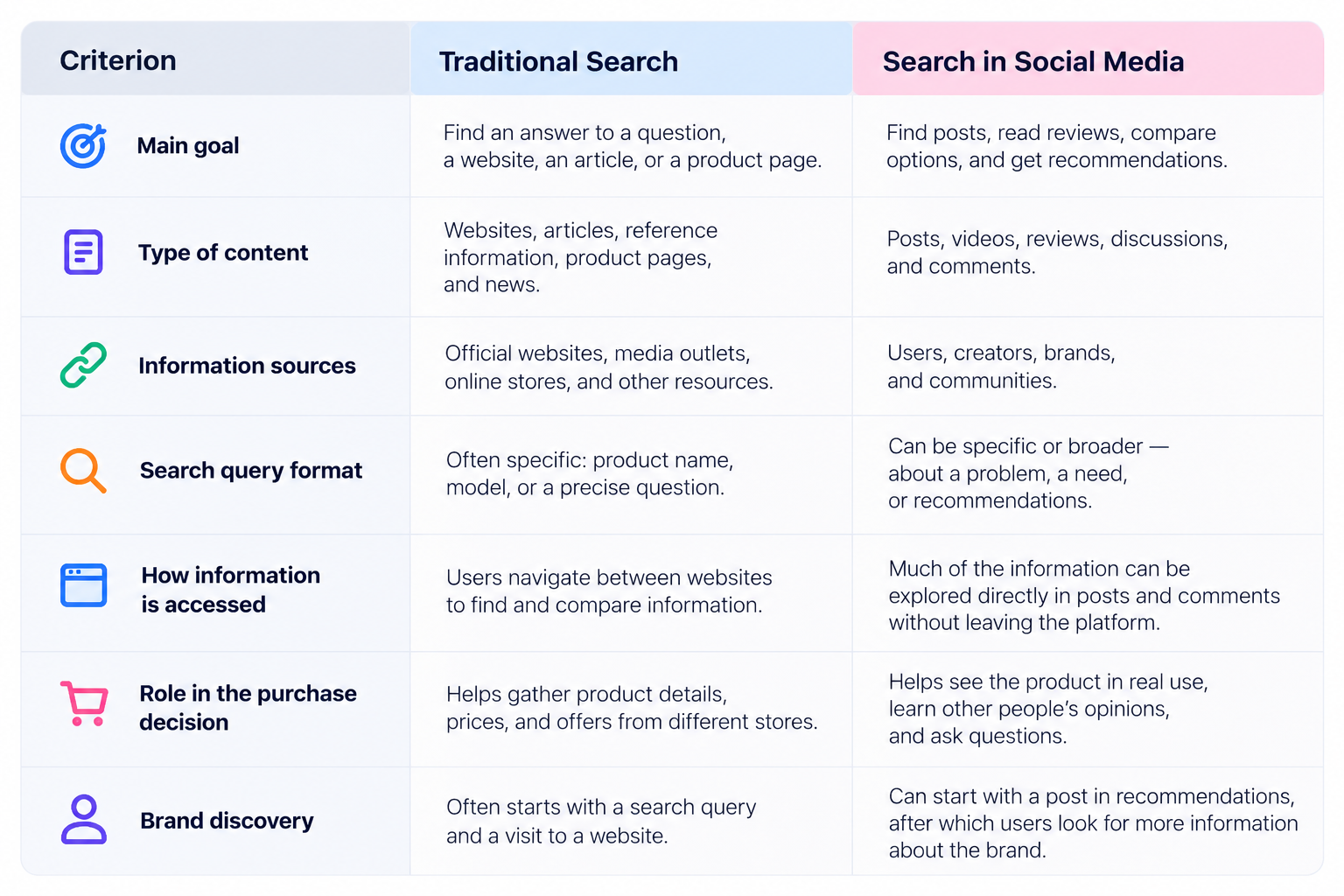
However, this distinction is not absolute. Search engines also display videos and posts from social media, while social platforms can direct users to company websites and online stores.
Users also don’t always start with a specific search query. They might first come across a product in their feed or recommendations, become interested in it, and then look for reviews and additional information.
This means that discovering a company and searching for information about it can happen in different sequences.
How companies can adapt content to users’ search behavior
When setting up profiles and creating posts, companies should consider how users search for products and brands on social media. Clear wording, appropriate content formats, and up-to-date information make it easier for people to find what they need.

1. Using clear wording
Post titles should be clear and accurately reflect their content. For example, instead of “Our Daily Tips,” it’s better to use “How to Choose a Laptop for Work,” so users immediately understand what the post is about.
This is especially important for people visiting an account for the first time. Post descriptions should provide enough detail to explain what users can expect from the content. This makes it easier for them to find relevant information and decide whether a product meets their needs.
2. Choosing the right format and demonstrating the product
The format of a post depends on the information it needs to communicate. For example, a video can show a product in use, a text post can explain its features, and a carousel can compare several options to help users choose the right one. A tech review can demonstrate how a device works, while a cosmetics post can show a product’s texture and the results of using it.
3. Optimizing the profile
The account name and profile description should clearly explain what the company does and what it offers. This helps users quickly determine whether the page is relevant to their needs.
4. Keeping information up to date
Prices, product specifications, and purchasing terms can change, so information in profiles and posts should be updated regularly.
Companies should also monitor how audiences respond to their content and which posts attract the most interest.
How to measure the effectiveness of social media content
Content effectiveness can be measured not only by likes and comments but also by how well it helps users find information about a company and its products. Several metrics are worth considering.

1. Reach and views
Reach and views show how many users have seen a post. If people who don’t follow the account are also viewing it, the content may be relevant to a wider audience.
However, posts can appear in feeds, recommendations, and search results, so high reach doesn’t necessarily mean that users discovered the content through search.
2. Profile visits and link clicks
After viewing a post, users may visit the profile to learn more about the company or explore other products. This can indicate that the content has sparked their interest.
Link clicks show how many users wanted to learn more about a product or visit the company’s website. If a social media platform provides traffic source data, companies can use it to assess the role search plays in attracting their audience more accurately.
3. Saves and comments
Saves may indicate that users find a post useful and want to return to it later. For example, they might save instructions, product reviews, or comparisons.
Comments reveal what questions users have and what they want to know about a product. By analyzing discussions, companies can identify which topics attract the most interest and what they should cover in future posts.
These metrics help companies understand which types of content interest their audience and what to focus on when creating new posts.

Search behavior on social media depends not only on users’ queries but also on how content is presented. Clear titles, detailed descriptions, and up-to-date information help users find relevant posts, while analyzing reach, profile visits, link clicks, saves, and comments helps companies assess audience responses.
Individual metrics don’t tell the whole story, so it’s important to consider them together. This gives companies a better understanding of which posts resonate with their audience and what they can change or improve in their future content strategy.

Try Popsters Trial plan to get content activity statistics of any pages for a next 7 days for free
Try for free
Popular
-
 Instagram Statistics and Analysis: How to View Data of any Account
-
 YouTube Analytics and Statistics for Other Channels
-
 How to Remove fake Followers on Instagram and Is It Necessary?
-
 How to Increase Telegram Subscribers: Best Free Ways
-
 Analytics and Statistics for Any Telegram Channel or Chat
Try Popsters Trial plan to get content activity statistics of any pages for a next 7 days for free
Try Popsters